

What adaptations help seniors with visual impairments?
Seniors with low vision or blindness often remain capable of making decisions, managing routines, and participating in community life when the environment is designed for safe, predictable movement. In assisted living, useful adaptations usually combine better lighting, clear organization, accessible communication, and staff practices that support independence without taking over.
Vision loss varies widely. Some residents may have difficulty seeing in dim areas, while others may experience glare, tunnel vision, blurred central vision, reduced depth perception, or complete blindness. Adaptations should be based on the person’s specific abilities rather than on a diagnosis alone.
How should lighting be adjusted?
Even, well-placed lighting can reduce falls and make everyday tasks easier. Brightness alone is not enough; glare and sharp contrasts can make vision problems worse.
Helpful adjustments include:
- Using steady, diffuse lighting in hallways, bedrooms, bathrooms, dining areas, and activity rooms
- Adding task lighting near reading chairs, sinks, closets, and medication areas
- Keeping stairways and changes in floor level consistently illuminated
- Reducing glare from polished floors, windows, mirrors, and highly reflective surfaces
- Using night-lights or low-level pathway lighting between the bed and bathroom
- Replacing burned-out bulbs promptly and checking that switches are easy to locate
Natural light can help, but direct sunlight may create glare. Curtains, blinds, or adjustable shades allow residents to control brightness throughout the day. In Butler, winter days can be shorter and outdoor conditions may change quickly, so indoor walkways should remain adequately lit even during daytime hours.
Why do color contrast and visual organization matter?
Color contrast helps residents distinguish important objects from their surroundings. A light-colored bathroom fixture against a similarly light wall may be difficult to see, while stronger contrast can make the fixture easier to locate.
Practical examples include:
- Contrasting toilet seats, grab bars, and sink fixtures with nearby surfaces
- Using brightly contrasting tape on the edge of a step when appropriate
- Choosing plates that contrast with the table surface and food
- Marking light switches, door handles, and frequently used controls
- Keeping furniture in consistent positions
- Avoiding busy patterns on rugs, upholstery, and flooring
A common misconception is that rearranging furniture creates variety or improves a room’s appearance without affecting safety. For someone with low vision, unexpected changes can make a familiar path hazardous. Furniture should be moved only after the resident knows what is changing and has time to learn the new layout.
How can assisted living staff support safe navigation?
Residents with visual impairments often benefit from consistent verbal information and respectful orientation. Staff should identify themselves when entering a room, explain what is happening, and avoid touching or guiding a resident without permission.
Useful communication habits include:
- Saying the person’s name before beginning a conversation
- Describing the location of nearby furniture or obstacles
- Giving specific directions such as “the chair is two steps ahead on your left”
- Explaining when a meal, medication, activity, or room arrangement has changed
- Offering an arm for guidance rather than pulling or pushing
- Announcing when leaving so the resident is not speaking to an empty room
- Keeping hallways, doorways, and emergency exits free of carts, boxes, and equipment
Guidance should be offered without assuming that a resident cannot walk independently. Some people may prefer a human guide, while others may use a cane, walker, tactile cues, or memorized routes.
What changes can improve bathrooms and bedrooms?
Bathrooms require particular attention because water, smooth surfaces, poor lighting, and tight spaces can increase fall risk. Adaptations may include nonslip flooring, stable grab bars, contrasting fixtures, accessible controls, and clear paths to the toilet and shower.
The bathroom should also have enough space for mobility equipment if the resident uses a walker or wheelchair. Towels, toiletries, and personal items should be stored in consistent locations rather than moved from day to day.
In bedrooms, beds should be positioned so the resident can reach the call system, lamp, glasses, mobility aid, and personal belongings without stretching or navigating around obstacles. Cords should be secured, and loose rugs should be removed. Clothing drawers can be labeled with large print, tactile markers, or a consistent arrangement that the resident recognizes.
How can meals, medications, and personal belongings be made easier to manage?
Visual impairment can affect more than walking. It may make it difficult to identify food, read labels, distinguish pills, or locate personal items.
Helpful strategies include:
- Describing the position of food on a plate using a clock-face method
- Using cups, plates, and utensils with useful contrast
- Providing large-print, high-contrast, or audio information when available
- Keeping medications organized according to the resident’s care plan
- Using tactile labels or large-print labels when appropriate
- Storing glasses, magnifiers, canes, and other aids in the same location
- Checking that clothing, toiletries, and personal items are not mixed with another resident’s belongings
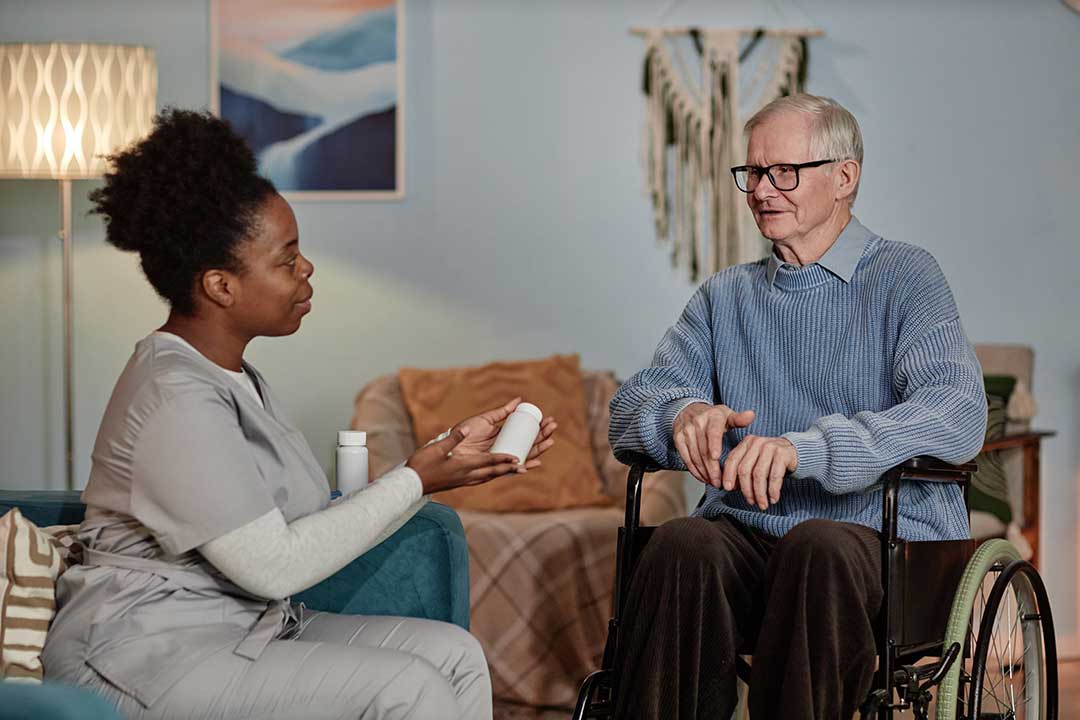
Medication changes should be communicated clearly. A resident should not be expected to identify unfamiliar pills by color or shape alone. Medication administration in assisted living must follow the resident’s care plan and applicable safety procedures.
What technology can support independence?
Technology may help residents read, communicate, navigate, and stay connected. The most useful tools are those the resident already understands or is willing to learn.
Examples include:
- Phones or tablets with enlarged text and voice-control features
- Talking clocks, timers, and room devices
- Electronic magnifiers
- Audio books and accessible activity materials
- High-contrast keyboards and simplified remote controls
- Door or room identifiers with large print and tactile markings
Technology should not replace human explanation. Devices need to be charged, maintained, and set up in a way that avoids unnecessary complexity. Staff should also know how to respect privacy when assisting with phones, messages, or digital accounts.
How should outdoor areas and seasonal conditions be handled?
Outdoor paths should be even, clearly marked, and free of branches, leaves, ice, and other obstacles. Seasonal maintenance matters in Butler, where snow, freezing temperatures, wet pavement, and early darkness can affect visibility and footing.
Residents with low vision may need extra time to adjust between indoor and outdoor lighting. Staff can help by explaining changes in terrain, weather-related hazards, wet floors, or temporary barriers. Outdoor seating and walking routes should remain familiar, and any construction or maintenance should be communicated before a resident uses the area.
Sunglasses, brimmed hats, or glare-reducing lenses may help some residents outdoors, but preferences differ. A vision specialist can advise on optical aids when ordinary glasses no longer provide adequate support.
What should families ask about during a care discussion?
Families and residents can ask how the assisted living setting handles vision-related needs, including:
- Whether lighting and flooring are reviewed for glare and contrast
- How staff document a resident’s preferred routes and guidance methods
- How emergency announcements and evacuation directions are communicated
- Whether menus, activity schedules, notices, and care information are available in accessible formats
- How changes to furniture, rooms, and common areas are announced
- How staff respond if vision changes suddenly
Sudden vision loss, new flashes or floaters, eye pain, or a rapid increase in difficulty seeing should be reported promptly to a qualified medical provider. Environmental adaptations improve safety, but they do not replace evaluation of a new or worsening eye problem.
